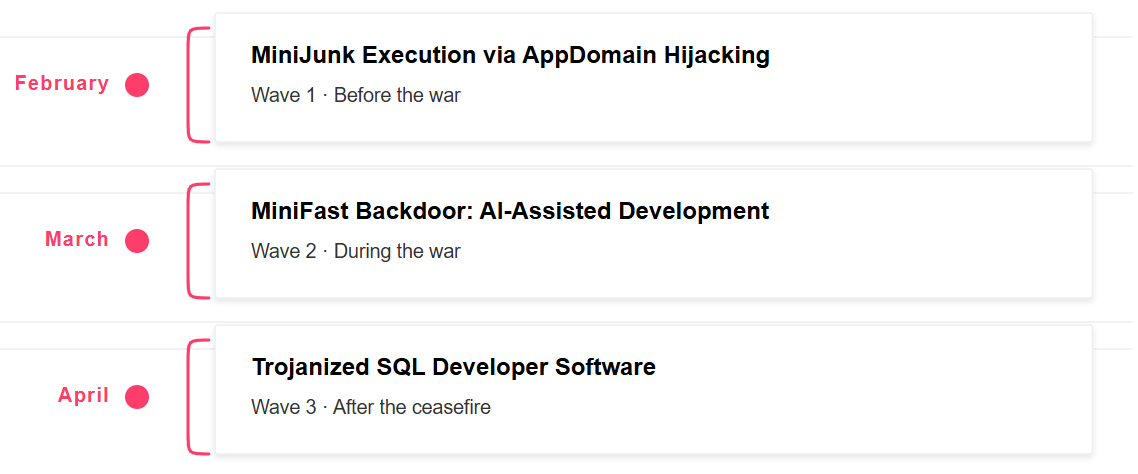
Nimbus Manticore, an IRGC-affiliated threat actor also tracked as UNC1549, resurfaced during Operation Epic Fury with new infection chains, including AppDomain Hijacking, SEO poisoning, and a newly identified backdoor named MiniFast. The campaign used phishing lures, a Trojanized Zoom installer, and a fake SQL Developer download site to target aviation and software organizations across the United States, Europe, and the Middle East. #NimbusManticore #UNC1549 #MiniFast #MiniJunk #Zoom #SQLDeveloper
Keypoints
- Nimbus Manticore is an IRGC-affiliated threat actor that has long targeted defense, aviation, and telecommunications organizations.
- During Operation Epic Fury, the group introduced new tradecraft, including AppDomain Hijacking, SEO poisoning, and AI-assisted malware development.
- The campaign used career-themed phishing lures and a Trojanized Zoom installer to deploy malware while blending into legitimate software activity.
- A previously undocumented backdoor named MiniFast replaced the earlier MiniJunk malware family in the latest operation.
- The group abused scheduled tasks, trusted digital signatures, and legitimate executables to persist and evade detection.
- A fake SQL Developer download site was promoted through SEO poisoning to deliver the MiniFast payload to unsuspecting users.
- MiniFast provides extensive remote control capabilities, including file operations, process management, command execution, persistence, and C2 communication.
MITRE Techniques
- [T1055 ] Process Injection – The actor used AppDomain Hijacking to load malicious DLLs through trusted .NET applications and Zoom-related executables (‘abusing AppDomain Hijacking for execution’ and ‘the .NET runtime loads the DLL’).
- [T1566 ] Phishing – The campaign relied on fake career opportunities and meeting-invitation lures to deliver malicious archives and installers (‘career-themed phishing campaigns’ and ‘fake meeting invitations’).
- [T1204 ] User Execution – Victims had to download and launch weaponized ZIP archives or installers for the infection to begin (‘After Setup.exe is launched by the user’).
- [T1036 ] Masquerading – Malicious files and sites impersonated legitimate software and organizations, including Zoom, Accenture, airline brands, and SQL Developer (‘masquerading as a US-based airline’ and ‘fake website impersonating a download page for SQL Developer’).
- [T1218 ] System Binary Proxy Execution – A Microsoft-signed Setup.exe and the legitimate Zoom installer were abused to execute malicious DLLs and stage the infection chain (‘Benign Microsoft-signed binary’ and ‘launched the legitimate Zoom installer’).
- [T1574.009 ] Dynamic Linker Hijacking: AppDomain Manager – The malware used a Trojanized .config file to point AppDomainManager to attacker-controlled DLLs (‘placing a Trojanized XML .config file’ and ‘points to a malicious DLL’).
- [T1036.005 ] Match Legitimate Name or Location – The malware wrote files into application-like directories and renamed binaries to appear legitimate (‘written into C:UsersAppDataLocalPackages’ and ‘now renamed to Update.exe’).
- [T1112 ] Modify Registry / Scheduled Task / Task Hijacking – The malware hijacked a Zoom-created scheduled task and later created or updated a task named WindowsSecurityUpdate (‘hijacks and modifies it to execute the second-stage component’ and ‘creates or updates a scheduled task named WindowsSecurityUpdate’).
- [T1057 ] Process Discovery – MiniFast enumerated running processes and returned names and PIDs (‘Enumerate Processes’).
- [T1083 ] File and Directory Discovery – The backdoor listed files and folders within a specified directory (‘Lists files and folders inside a specified directory’).
- [T1105 ] Ingress Tool Transfer – MiniFast downloaded files from the C2 server and uploaded local files back to it (‘Downloads a file from the C2 server’ and ‘Uploads local files’).
- [T1027 ] Obfuscated Files or Information – The loaders used ROT13, reversed strings, Base64, and encrypted payloads to hinder analysis (‘decrypted at runtime using a simple combination of ROT13 encoding and reversed-string transformations’).
- [T1497.001 ] Virtualization/Sandbox Evasion: System Checks – The malware performed process-chain validation and anti-analysis checks to avoid sandbox execution (‘only continues execution if: The hosting process name is update.exe’ and ‘the parent process is svchost.exe’).
- [T1071.001 ] Application Layer Protocol: Web Protocols – The backdoor used HTTP-based API-style communication with JSON and Base64-encoded task data (‘communicates with its C2 infrastructure using an API-style architecture with JSON-formatted data exchanges’).
- [T1001 ] Data Obfuscation – Tasking and result data were Base64-encoded before transmission (‘Base64-encoded serialized task structures’ and ‘Base64-encoded and submitted back’).
- [T1021.004 ] Remote Services: SSH/Remote Desktop? – Not mentioned in article.
- [T1053.005 ] Scheduled Task/Job: Scheduled Task – The malware relied on a Zoom installation task for persistence and later created its own WindowsSecurityUpdate task (‘abusing an existing Zoom scheduled task’ and ‘scheduled task named WindowsSecurityUpdate’).
Indicators of Compromise
- [SHA256 ] Malware sample hashes for loaders, payloads, and infrastructure-related binaries – 10fd541674adadfbba99b54280f7e59732746faf2b10ce68521866f737f1e46d, eee657ffdb2af8ed6412221e7d5fbf4f5742f2ac2c88f43f12db46af0697de71, and 25 more hashes
- [Domain ] Phishing, SEO-poisoning, and infrastructure domains used to deliver MiniFast – getsqldeveloper[.]com, business-startup[.]org, and other 18 domains
- [File names ] Malicious archives, loaders, and renamed binaries used in the infection chain – Zoominstall64.zip, UpdateChecker.dll, and uevmonitor.dll
- [File paths ] Locations where staged payloads were extracted or copied during execution – C:UsersAppDataLocalPackages, C:UsersAppDataLocalZoombinupdate
- [Certificate subjects ] Valid signing certificates abused to sign malicious files – Gray Matter Software S.R.L., Kirubel Kerie Negeya
- [User-Agent string ] Browser impersonation string used by MiniFast for C2 traffic – Mozilla/5.0 (Windows NT 10.0; Win64; x64) AppleWebKit/537.36 (KHTML, like Gecko) Chrome/146.0.0.0 Safari/537.36